
3mm 4-ply birch plywood: what changes on the laser and when to choose it

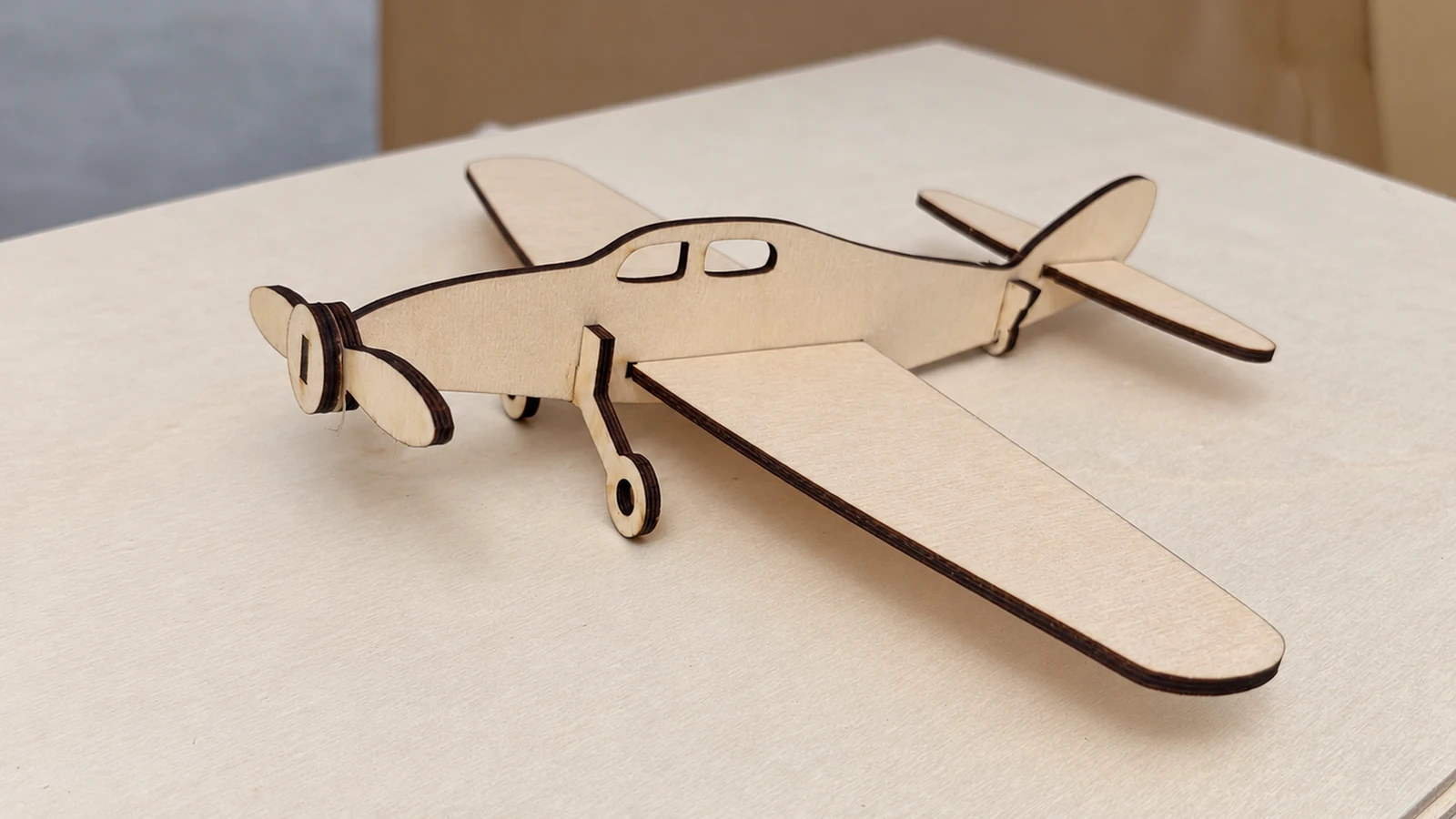
3mm 4-ply birch plywood is a Finnish birch panel, B/B grade, made from four veneers instead of three. On the laser it leaves a light edge and its thickness is more consistent, and we recommend it for interlocking parts, toys and pieces on show. On our xTool S1 40W diode laser we cut it in one pass, at 100% and 15 mm/s with air assist.
In short
Four Finnish birch veneers, with faces free of joints and patches on both sides (B/B). Compared with 3-ply, the edge comes out lighter and less burnt, and the thickness tolerance is tighter. On the xTool S1 40W we cut it at 100% power, 15 mm/s, 1 pass, air assist on.
For children’s toys it is the safer of the two, because its glue is compliant for use in toys. It suits you if you make interlocking parts, scale models, toys, architectural models or objects seen from both sides. If you make prototypes, simple decorations or large runs and want to spend less, 3-ply is enough.
How 4-ply is built
Four rotary-cut birch veneers, glued with the grain crossed:
- face: thin, about 0.5 mm;
- two cores: thicker, about 1 mm each, with the grain running the same way as each other and crossed to the faces;
- back: thin, about 0.5 mm.
The two parallel cores keep the panel symmetrical: the sequence is the same above and below the centre, which helps it stay flat.
3-ply has three veneers: face, core and back, with the core crossed to the faces. It is symmetrical too; what changes is the number of veneers and the two parallel cores.
The glue in our 4-ply is light-coloured and flexible, and it doesn’t darken when cut: that helps the edge too.
B/B grade
B/B means both faces are grade B: sound surface, the odd small tight knot, slight variations in tone, no patches and no repairs. You can use either side. Photos of every grade are in our guide to birch panel grades.
4-ply or 3-ply: the differences that matter on the laser
| 3-ply | 4-ply | |
|---|---|---|
| Veneers | 3 (face, core, back) | 4 (face, 2 cores, back) |
| Thickness tolerance (product page) | ±0.5 mm | ±0.2 mm |
| Edge after cutting (our test) | darker | light, less burnt |
| Price | lower | higher |
| What we recommend it for | prototypes, decorations, large runs | interlocking parts, scale models, toys, architectural models, pieces on show |
With interlocking parts, tolerance is what you notice most. At ±0.2 mm the same slot fits much the same from one end of the sheet to the other; at ±0.5 mm you more often have to test and adjust.
Our test on the xTool S1 40W
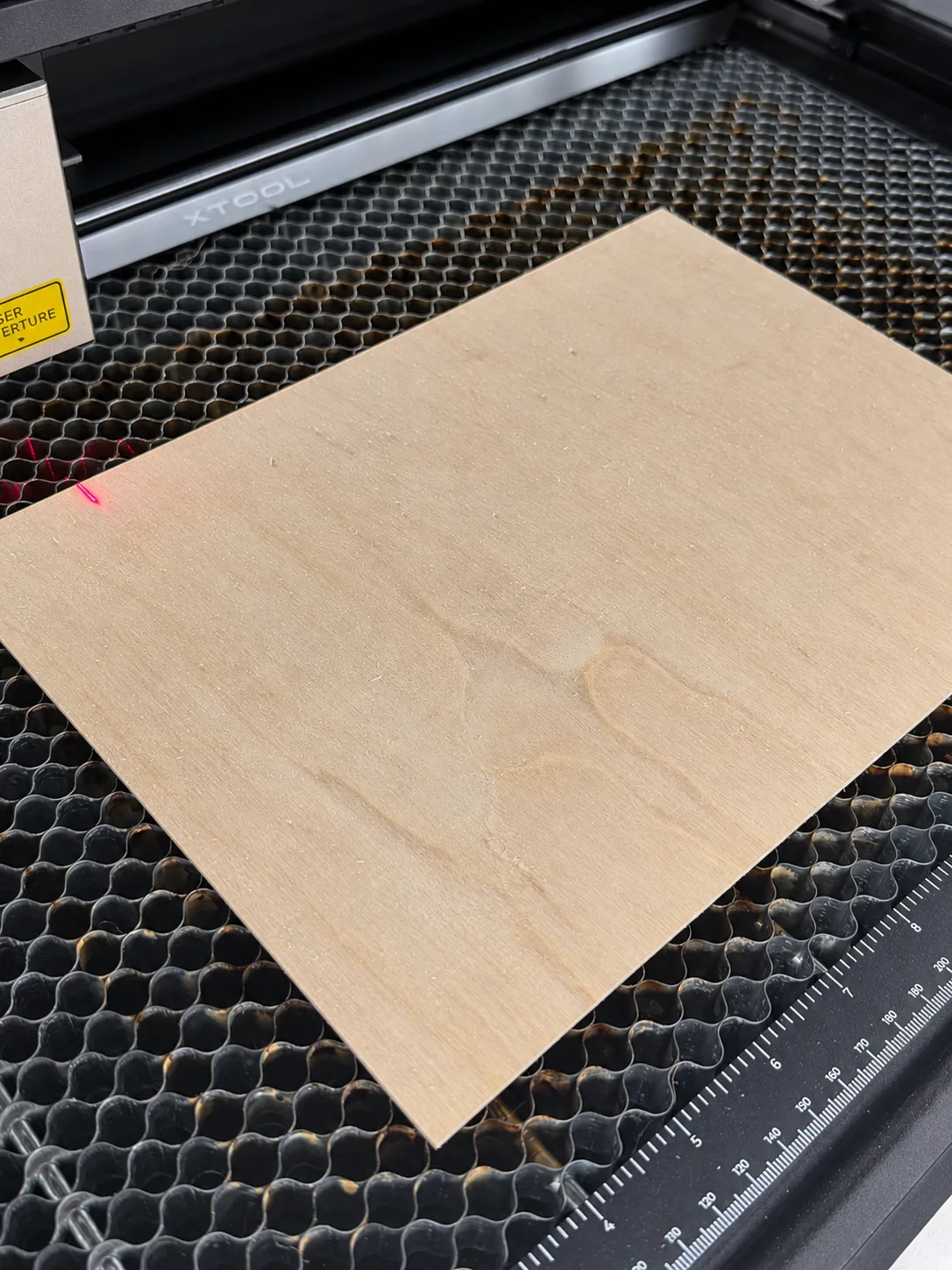
We tested the panel on 2 October 2026 with our xTool S1 40W diode laser and xTool Creative Space.
Cutting. At 100% power, 15 mm/s, 1 pass and air assist on, the panel cuts right through, cleanly, with a smooth surface and a light edge, less burnt than the birch we normally use.
Smoke. Lots of it. Keep extraction and air assist on the whole time: that is also what keeps the edge light.
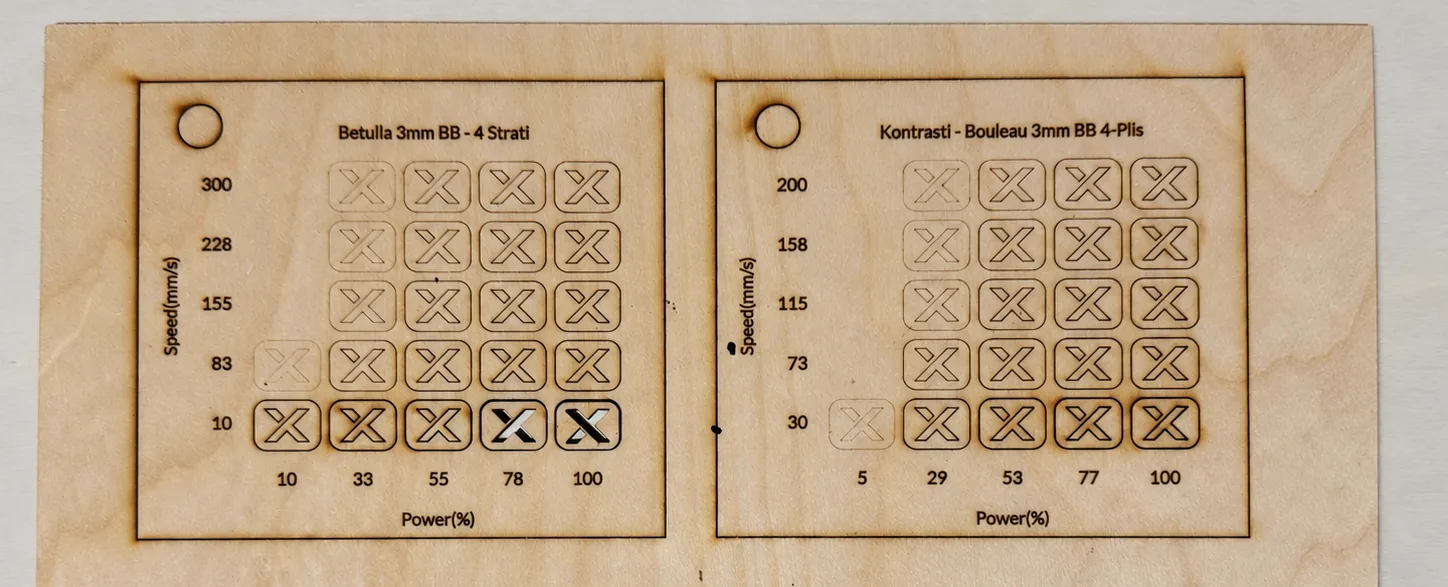
Test grids. In the first grid (10 to 300 mm/s, power 10 to 100%) only two squares cut through, both at 10 mm/s: at 78% and at 100%. The rest only engraved. The second grid (30 to 200 mm/s, 5 to 100%) gave engraving only.
Engraving. The grids show a wide range of tones, from light to dark. For text and logos you have plenty of shades to choose from.
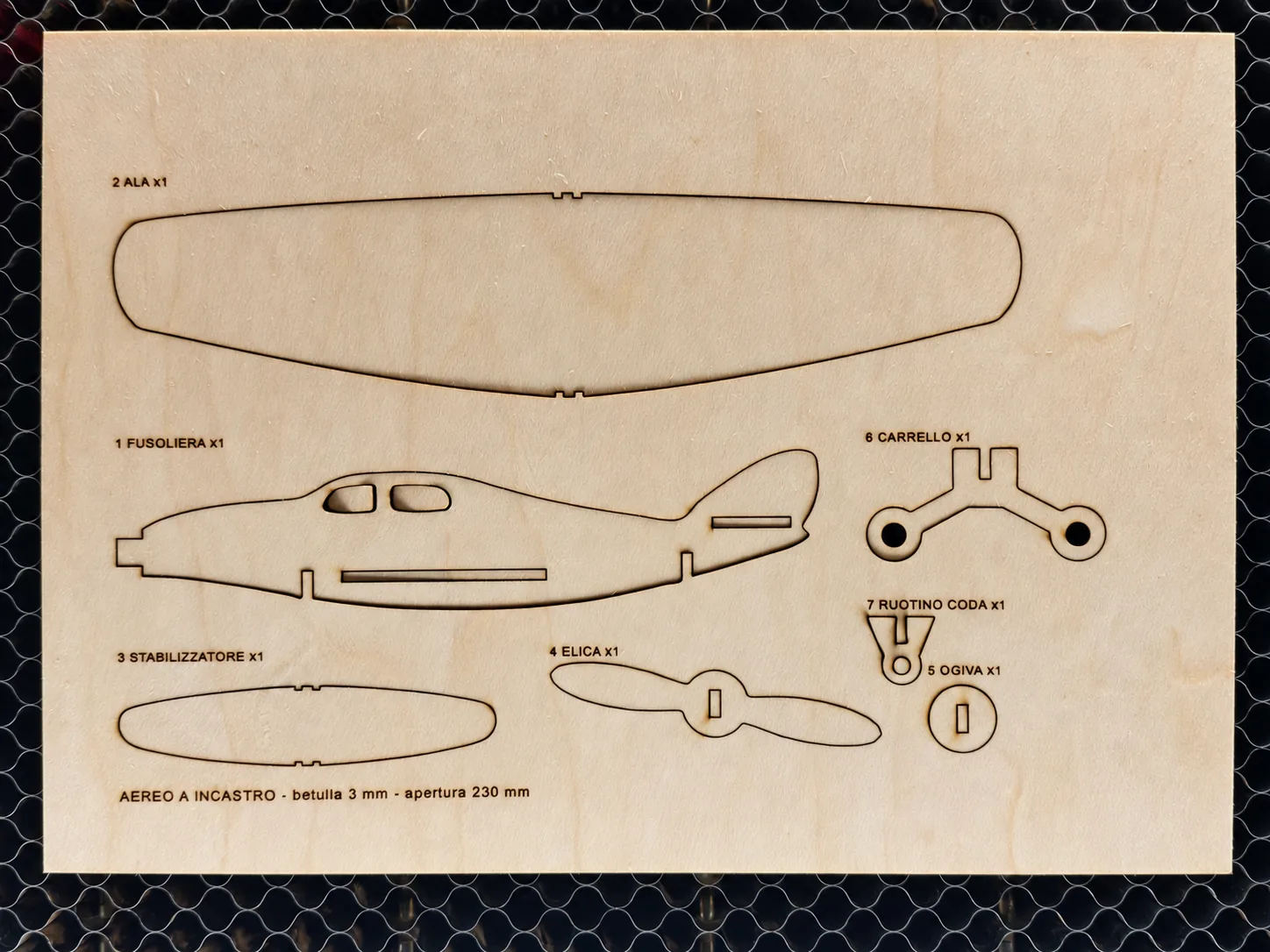
Real-world test. From a single sheet we cut an interlocking plane with a 230 mm wingspan, with the name of each part engraved in the same job. The parts fit together: the finished plane is the one in the photo at the top.
Settings at a glance
| Job | Power | Speed | Passes | Air assist | Result |
|---|---|---|---|---|---|
| Cut | 100% | 15 mm/s | 1 | Yes | Through, light edge |
| Cut (grid) | 78% and 100% | 10 mm/s | – | – | Through |
| Engrave (grids) | 5–100% | 30–300 mm/s | – | – | Light to dark tones |
These are the values for our machine. On a different laser, run a grid on an offcut first.
Who it’s for, and who it isn’t
4-ply is worth it if you cut interlocking parts and model kits, make children’s toys or architectural models, or if the piece is seen from both sides with the edge on show. For toys it is the safer of the two, because the glue is compliant for use in toys.
For prototypes, simple decorations or lots of copies of the same part, 3-ply is enough: there a darker edge and a few tenths of a millimetre either way in thickness don’t change the result, and it costs less.
If you need 3mm birch in general, we have also written about why 3mm is the go-to thickness for laser work.
Frequently asked questions
What is the difference between 3-ply and 4-ply 3mm birch plywood?
3-ply has three veneers: face, core and back. 4-ply has four: two thin faces of about 0.5 mm and two cores of about 1 mm with the grain running the same way. Our 4-ply has a tolerance of ±0.2 mm versus ±0.5 mm and leaves a lighter edge on the laser.
What settings should I use on an xTool S1 40W?
For cutting: 100% power, 15 mm/s, 1 pass, air assist on. For engraving, everything we ran between 30 and 300 mm/s in our grids engraved only, with a wide range of tones. Before a long job, run a grid on an offcut.
Can a 40W diode laser cut 4-ply in one pass?
Yes. In our test the xTool S1 40W cut it in one pass at 15 mm/s and 100% power, with air assist.
Does the edge stay light?
Yes, with air assist on. The panel gives off a lot of smoke, so you need good extraction.
Is 4-ply birch plywood suitable for children’s toys?
Yes, it’s the version we recommend for toys: the glue is compliant for use in toys. Checks on the finished toy, such as paints and small parts, remain the responsibility of whoever makes it.
What does B/B grade mean?
That both faces are grade B: small tight knots, slight variations in tone, no patches and no repairs.
3mm birch plywood is in the shop: choose the 4-Ply option. Every thickness is in the birch plywood category. If you have questions about your machine, email us at info@kontrasti.co.
 Wood veneer


